
Precision spine surgerythrough tiny incisions
Five reasons patients choose biportal endoscopy
Less invasive
Two incisions under 1 cm. Instruments glide between natural structures instead of cutting muscle.
Less pain
Muscles and surrounding tissue are largely preserved, so patients often need less pain medication.
Faster recovery
Many patients return home sooner and resume their daily activities faster.
Motion preserving
Targeted decompression keeps supporting structures intact and preserves spinal stability.
Highly aesthetic
Very small incisions leave significantly smaller, more discreet scars.
Living with spine pain — and what can be done
Living with spine-related pain can significantly limit your mobility, independence, and overall quality of life.
Degenerative conditions of the spine are among the most common health issues people experience over the course of their lifetime. These conditions develop gradually and can be influenced by various factors. The most frequent pathologies include herniated discs and spinal stenosis.
When conservative treatments such as medication, physical therapy, or injections no longer provide sufficient relief, surgical treatment may be considered as a next step.
The goal of an endoscopic decompression procedure is to relieve pressure on the affected nerves, thereby reducing pain and improving mobility and overall function.
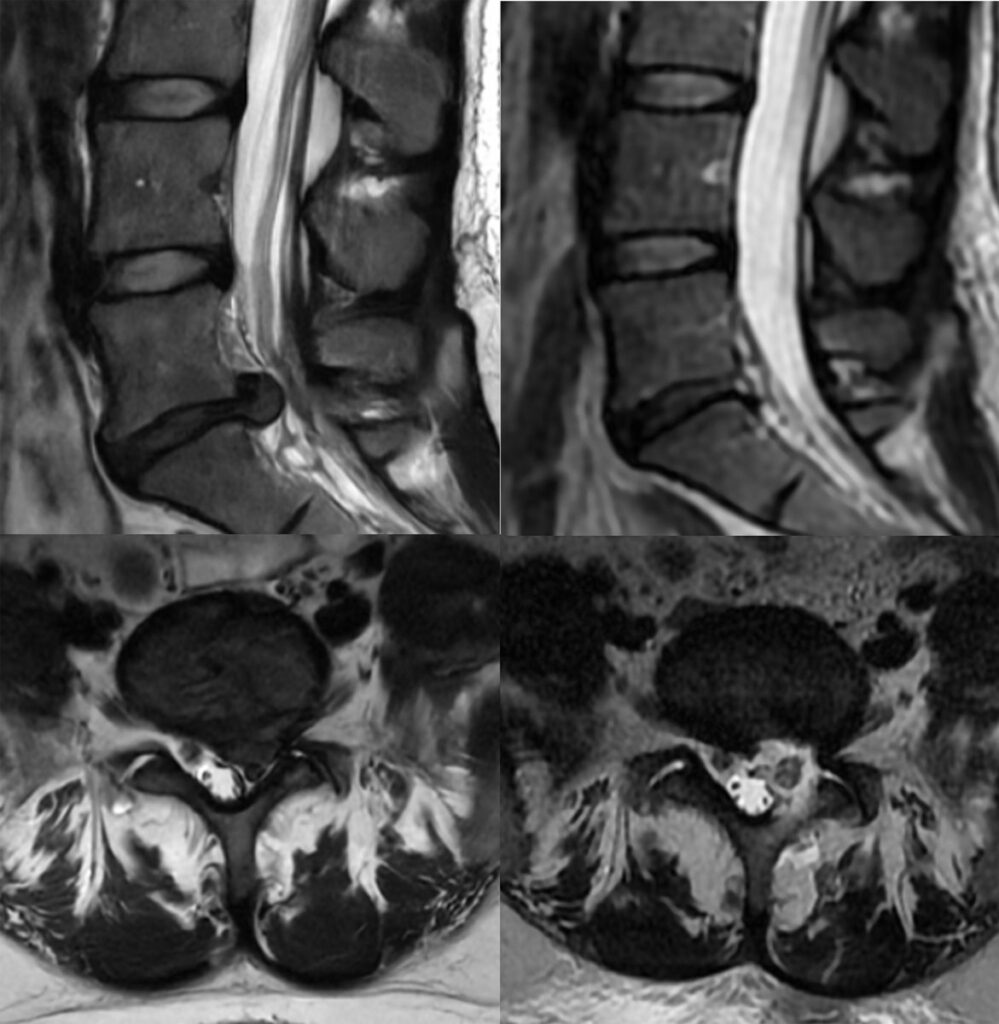
Left – before surgery: pre-operative MRI showing the disc herniation. Right – after surgery: post-operative MRI after biportal endoscopic decompression. Courtesy of Dr. Xavier A. Santander, MD, PhD
Understanding Endoscopic & Biportal Surgery
A closer look at the technique behind biportal endoscopy — and why it matters for your recovery.
What is Endoscopic Spine Surgery?
- Minimally invasive to normal anatomy through a keyhole approach, motion-preserving technique
- Typically below 10 mm small skin incisions
- High-definition camera visualization
- Targeted nerve decompression
- Minimal disruption to normal anatomy
What is Biportal Endoscopic Spine Surgery?
- Two separate portals enable visual clarity and optimal freedom of movement and thus surgical control
- High-definition visualization by the endoscope allows accurate and targeted surgery
- Continuous saline irrigation maintains a clear field
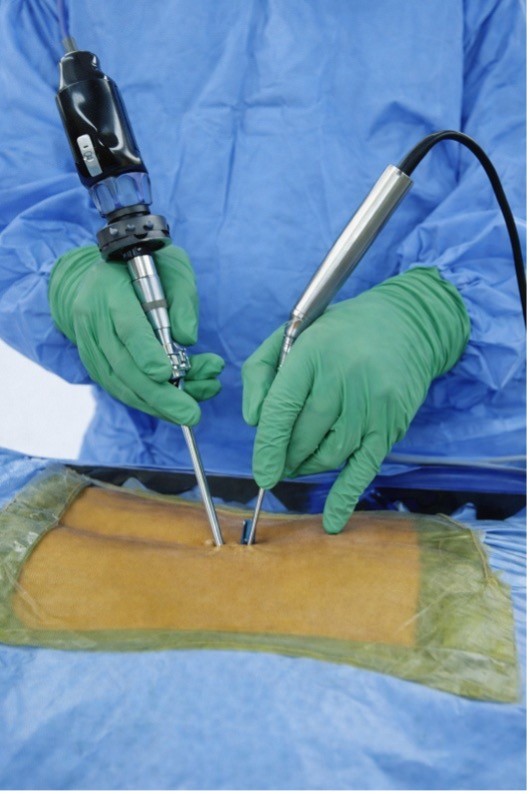
What does «Biportal» mean?
«Biportal» means using two small access points — one for the endoscopic camera and one for the surgical instruments. In technical terminology, it is also referred to as Unilateral Biportal Endoscopy (UBE).
An «unilateral» approach enables access to the spinal canal only from one side, minimizing tissue disruption.
What are the benefits of biportal endoscopy?
Less invasive and tissue-sparing1
Biportal endoscopic surgery is performed through two very small incisions. Instead of cutting muscles, instruments are guided between natural anatomical structures, helping to preserve important anatomy such as muscles or ligaments and thus spinal stability. The biportal endoscopy may even be done as outpatient surgery.
Reduced soft tissue damage & motion preserving4
A gentle, muscle-sparing approach minimizes cutting of soft tissues like fascia, muscles and ligaments. It allows targeted bone removal to what is strictly necessary. By preserving such supporting structures, overall tissue trauma is reduced — supporting faster healing.
Less pain and faster recovery1–4
As a result, patients typically experience less pain after surgery and often require less pain medication. The precise endoscopic view in combination with the very small incisions allows targeted treatment with minimal trauma. This supports smoother healing, enabling many patients to return home sooner and resume daily activities faster. In addition, the continuous use of saline fluid during the procedure helps keep the surgical area clean and supports good wound healing.
Small scars
Very small incisions lead to significantly smaller and more discreet scars compared to open or traditional minimally invasive surgery.
1 Simpson et al., 2021, The Spine Journal – 2 McGrath et al., 2019, JNS – 3 Hasan et al., 2019, JSS – 4 Lokhande et al., 2020, ISJ
Your Recovery: What to Expect
How to support a successful outcome after biportal endoscopic spine surgery.
Step 1
Mild discomfort is normal
You may feel mild soreness or tenderness around the two small incisions. This is part of healing and can normally be managed with oral pain medication — usually mild and short-lasting, very different from deep muscle pain after open surgery.
Step 2
Recovery is not always linear – “Good days and bad days”
Some days will feel better than others. This is completely normal and part of the healing process.
Step 3
Temporary activity restrictions
For a short time, you may need to avoid complete bending, heavier lifting, and twisting. These restrictions are only temporary and are key to ensuring a complete and lasting recovery.
1–3 months
Patience leads to lasting results
Many patients feel relief early, but full recovery may take 1–3 months. The goal is not just short-term pain relief — it is long-lasting mobility, comfort, and quality of life.
Get personalized guidance
Please contact us. We will be happy to provide personalized guidance and individual consultation tailored to your specific situation.
Nexon Medical delivers biportal endoscopic solutions across Europe, guided by Swiss quality standards and focused on faster recovery and less pain.