Making exceptional spine care reproducible.Preserve More. Disrupt Less.
Exceptional surgery changes one patient. Reproducible surgery changes healthcare.
Preserve More. Disrupt Less.
Every decision we make begins with one question: Does it help preserve more function by disrupting less tissue?
Progress in spine surgery does not scale through technology alone. It scales when the technique, learning pathway, clinical support, and evidence work as one system. Nexon’s EnSight™ UBE platform brings those elements together to help make tissue-preserving spine care teachable, supportable, and measurable in everyday practice.
Nexon – Shaping UBE in Europe
Nexon is leading the development of UBE in Europe — turning an exceptional surgical technique into a reproducible model for spine care.
Our leadership extends beyond technology. By combining the EnSight UBE platform with structured education, clinical evidence, and long-term implementation support, we help surgeons and hospitals to adopt UBE successfully into their daily practice.
We do not simply participate in the UBE category. We are shaping it.
How do patient outcomes in spine surgery compare to other surgeries?
Despite significant advancements in medical technology and surgical techniques, we understand that there is considerable room for improvement. We therefore endeavour to address the existing challenges and provide innovative solutions to optimize patient care.
Clear performance gap between spine, hip and knee surgery!
A landmark study from the Schulthess Klinik (Zurich, Switzerland), winner of the EUROSPINE 2017 Full Paper Award, measured and compared a patient experience performance indicator – Patient Accepted Symptom State (PASS) – for patients undergoing lumbar spine, hip and knee surgery. Around 90% of hip patients reach an acceptable symptom state after surgery, but only around 45% of patients after lumbar spine surgery.
Full study reference
EUROSPINE 2017 FULL PAPER AWARD: Time to remove our rose-tinted spectacles: a candid appraisal of the relative success of surgery in over 4500 patients with degenerative disorders of the lumbar spine, hip or knee (Mannion et al., Eur Spine J 2018;27:778–788).

A new perspective — the benefits of endoscopic spine surgery
Endoscopic spine surgery — monoportal or biportal — offers patient benefits superior to microsurgery, including low infection risk, minimal pain and fast recovery. Biportal endoscopy (UBE) builds on this with two independent portals — one for high-definition visualization, one for surgical instruments — for excellent visualization and more complex procedures.
20–40%
less post-op pain, endoscopy vs. microsurgery ²
76.3%
shorter hospital stay, endoscopy vs. microdiscectomy ³
29 days
less work absence ⁴
99.9%
less infection rate compared to other non-instrumented spine surgeries ¹
1 Simpson et al., 2021, The Spine Journal · 2 McGrath et al., 2019, JNS · 3 Hasan et al., 2019, JSS · 4 Lokhande et al., 2020, ISJ


Rethinking Spine Surgery
What are key challenges today?
Invasiveness in MIS with related length of hospital stay and recovery time
Despite being labeled “minimally invasive,” many procedures still require relatively wide access corridors.
How can OR-related trauma be reduced to minimize pain, hospital stay and recovery time?
The Learning Curve Challenge
Endoscopic techniques are ultra minimally invasive and powerful—but demanding. Many surgeons face a long learning curve, and traditional training pathways often fall short in building real procedural confidence.
How can a more intuitive transition and safe adoption be enhanced?
Complexity of instruments and sets
Endoscopic procedures frequently rely on specific instruments and disposables that may be less familiar in the usage. Setups are often more complex.
Investment Costs
Microscopes are often a major investment. Monoportal endoscopy may require multiple dedicated instrument sets for different indications, with long and highly specialized tools driving up costs and logistical complexity.
Is there a more versatile and efficient approach that simplifies both instrumentation and economics?
Patient satisfaction
While hip and knee surgery have seen consistently strong outcomes, spine surgery has historically faced greater challenges in patient satisfaction and recovery — a clear need in the treatment of spinal conditions.
How can spine surgery close the satisfaction gap seen in hip and knee outcomes?
Decompression & motion preservation vs. fusion
Achieving effective decompression while preserving natural stability is a constant trade-off — and over-reliance on fusion can limit long-term mobility.
How can effective decompression be achieved while preserving stability and reducing unnecessary fusion?
What if we could leverage the advantages of both worlds?
Open and endoscopic approach — without inheriting their limitations?
- Reducing soft tissue damage for less post-op pain, shorter hospital stay and faster return to work
- Preserving spinal stability and thus delaying spinal disease progression
- Using standardized, familiar and versatile instruments
- Facilitating intuitive handling and improved workflow efficiency
- Reducing the learning curve
- Offering a cost-effective solution
What UBE / Biportal
Endoscopy changes
Two portals – one tissue-preserving approach
UBE uses separate portals for visualization and instrumentation. This concept gives the surgeon independent working channels while preserving familiar surgical principles. This opportunity is larger than a technique: It is the foundation for a reproducible approach to tissue-preserving spine care.
How Nexon makes the position real
Technology
EnSight UBE brings together visualization, instruments, and workflow elements designed for UBE practice.
Mastery
A structured learning pathway supports deliberate practice, mentored cases, whole-team learning, and progression toward independent use.
Evidence
Published literature, data, and a growing clinical network build the proof behind reproducibility.
How does UBE compare to other surgical approaches?
| Microscopic | Monoportal (FESS) | Biportal (UBE) | |
|---|---|---|---|
| Visualization | Microscope | Endoscope (single portal) | Continuous HD endoscopy, independent view |
| Soft-tissue trauma | Higher | Low | Low – muscle-sparing corridor |
| Indication range | Broad | Mainly herniation | Herniation, stenosis, instability, fusion |
| Instrument familiarity | Familiar | Specialized, dedicated sets | Familiar, versatile, standardized |
| Investment | High (microscope) | Multiple dedicated sets | One versatile platform |
More: detailed comparison
| Microsurgery (MIS with tube and microscope) | Monoportal Endoscopy | Biportal Endoscopy (UBE) | |
|---|---|---|---|
| Indications | All types of discectomy, stenosis, to short construct fusion; from lumbar to cervical. | Mainly simple lumbar discectomy. | The same as microsurgery. |
| Visualization | Limited to a single and fixed orientation with a view from far above. Instruments obstruct vision. | Limited to a single port through which instruments are guided. Instruments may obstruct vision. | Camera moves independently to visualize the surgical site and instrument tips. Fusion possible under visualization. |
| Instruments | Large choice of instrument types and sizes. | Long and very thin instruments to enter the small-diameter shafts. | Same size as microscopic surgery – same efficacy. |
| Maneuverability | Unlimited up-down instrument movement, but inclination is restricted by the MIS tube. | Room for maneuverability limited to the endoscopic shaft. | Higher than microscopic surgery due to absence of tube and skin elasticity. |
| Invasiveness | One small incision; tissues are distracted during the entire surgery time. | One small incision. | Two small incisions. Tissue-preservation approach. |
| Surgical time | Highly variable depending on the patient pathologies, hospital setup and surgeon. | Faster than biportal for interlaminar or foraminal simple hernia, as no bone needs to be drilled. | Faster than monoportal for complex hernia, stenosis and fusion due to instrument size. |
| Learning curve | Current standard technique, learned during a long and progressive process during fellowship/residency. | Longer learning curve, easier for surgeons with experience in other monoportal surgeries. | Shorter than monoportal, especially for surgeons with experience in arthroscopy. |
| Investment | Highly expensive microscope, plus tube retractor and instrument set. | Several sets for different accesses and target areas. Specific drills and generator needed. | Economic solution: one single set for all indications. |
Endoscopic Spine Surgery will set new standards.
Current approaches often force a trade-off between invasiveness, precision, efficiency, and usability. What if we could combine the advantages of endoscopy with a more intuitive, versatile, and workflow-friendly approach? The Biportal Endoscopy (UBE) approach offers a compelling solution.


“The biportal endoscopy technique is relatively simple to adopt, as it relies on a more familiar approach, requires less expensive instruments, has a shorter learning curve, and is also well-suited for interbody fusion.”
What’s in it for me?
Nexon supports every stakeholder in the shift to biportal endoscopy — find the path that fits you.


Latest News
-
Read more →: EUROSPINE 2026 in Gothenburg: what comes after the first endoscopic cases?
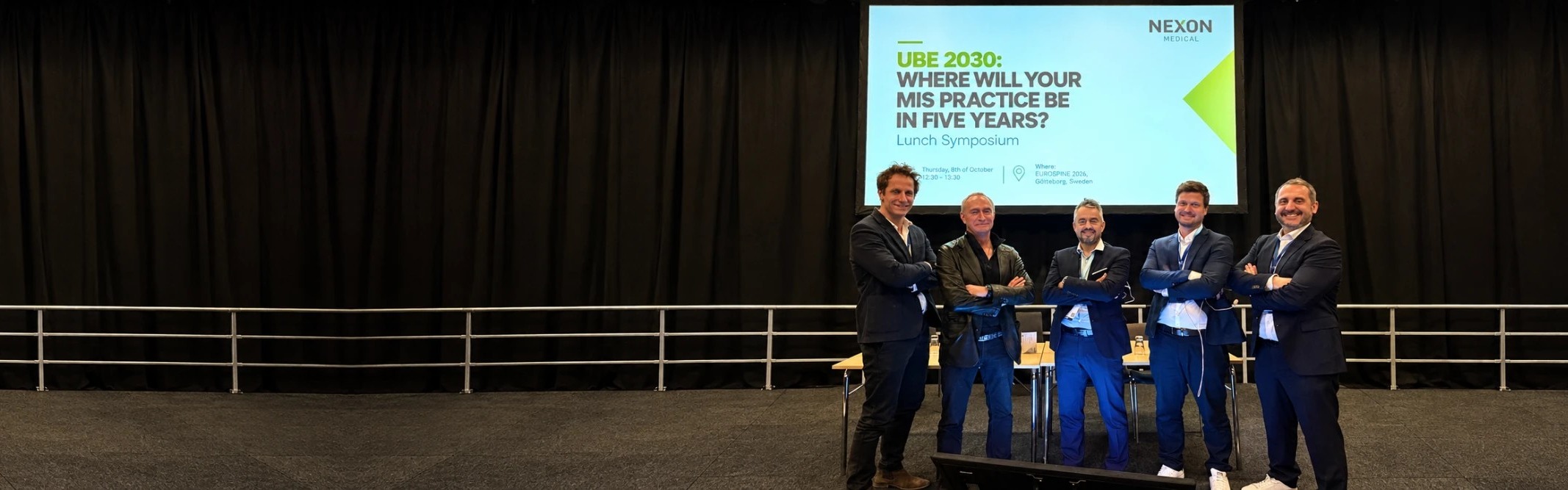
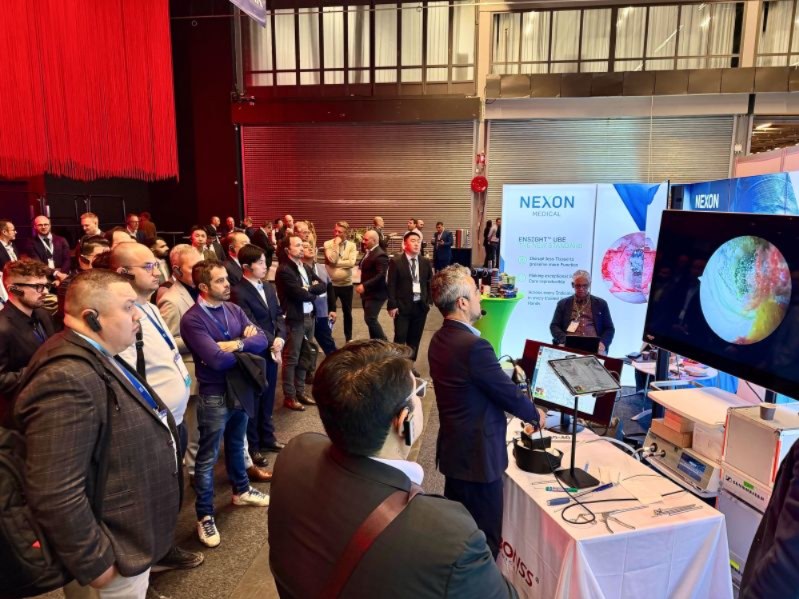
Three days, one question: what comes after the first endoscopic cases? Our week at EUROSPINE 2026, from the UBE Arena to the UBE 2030 Lunch Symposium.
-
Read more →: Three days, one question: what comes after the first endoscopic cases?
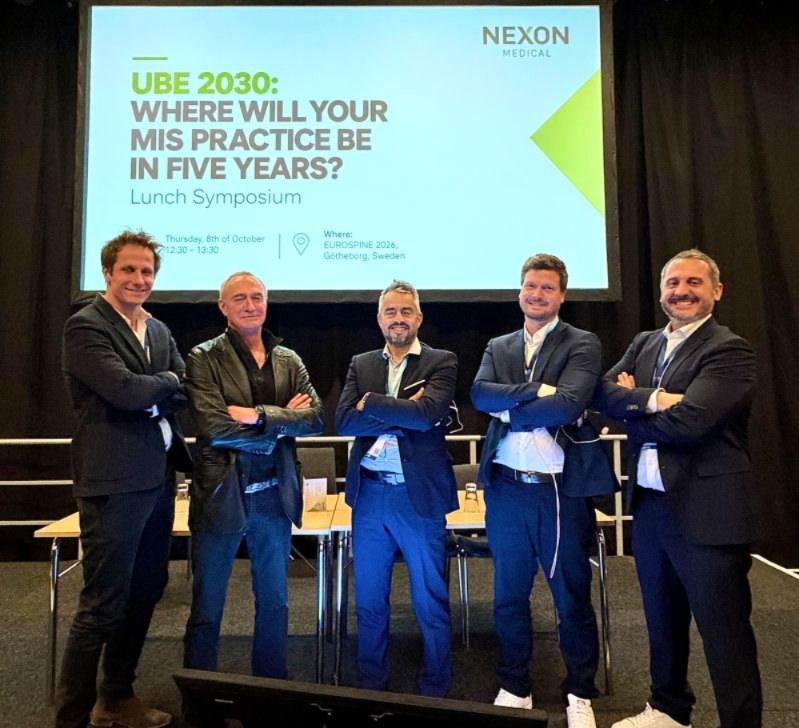
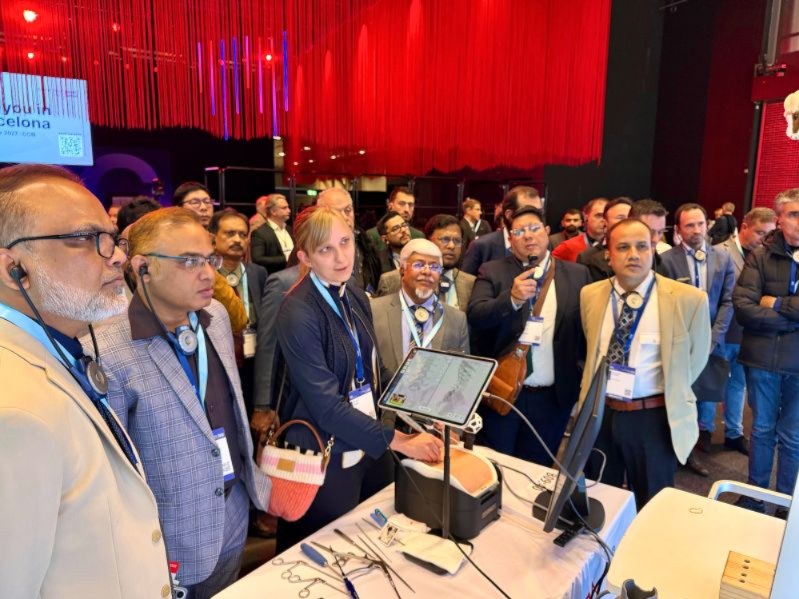
Our week at EUROSPINE 2026 in Gothenburg: the UBE 2030 Lunch Symposium, five live biportal simulator sessions in the UBE Arena and hands-on all three days.
-
Read more →: Eurospine Gothenburg is almost over. The UBE journey is just beginning.
Two days, four live sessions in the UBE Arena and the UBE 2030 Lunch Symposium behind us. On the last day: UBE-PCF live with Dr. Joseph Cristini and Dr. François Lechanoine.
-
Read more →: UBE 2030 Lunch Symposium: how the next years will shape the future of spine surgery
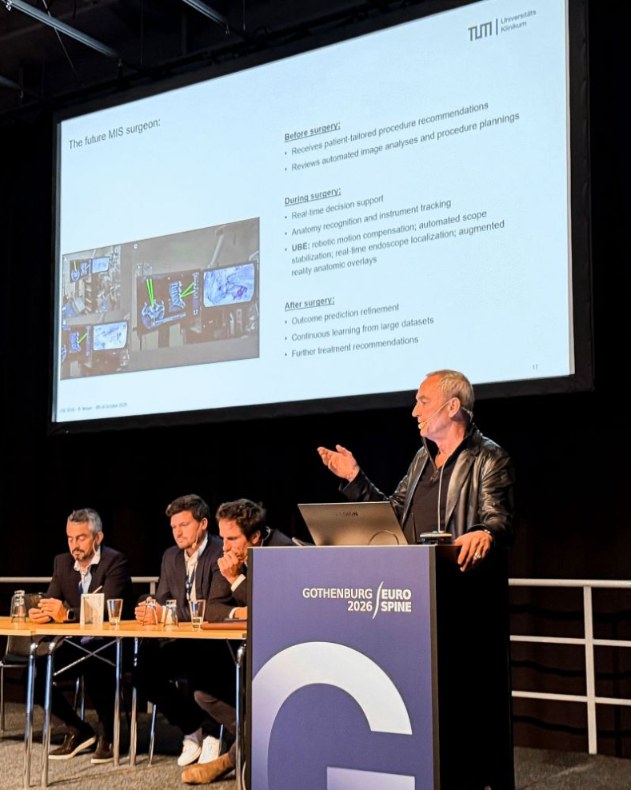
From the two-handed architecture and ten years of evidence to complex cases, the OR of the future and an open debate on where to start. Thank you to our faculty.
-
Read more →: UBE 2030: Where will your MIS practice be in five years?
One hour, five surgeons from across Europe, one open debate: the UBE 2030 Lunch Symposium, 12:30–13:30 in Room A2, plus two live cervical sessions in the UBE Arena.
-
Read more →: Exciting start at EUROSPINE 2026
The UBE Arena opened: UBE-ULBD with PD Dr. Nicole Lange, the paraspinal approach with Prof. Dr. Martin N. Stienen and a biportal hands-on station open all day.
-
Read more →: EUROSPINE 2026 opens today. The part we look forward to most has no slides.
Live biportal simulator surgeries during the coffee breaks, each led by an experienced UBE surgeon, in the UBE Arena at booth B09:40.
-
Read more →: Five surgeons. Five perspectives. One hour.
At EUROSPINE, Dr. Joseph Cristini and our faculty open a different conversation: the decisions that shape an endoscopic practice over time. 8 October, 12:30–13:30, Room A2.